Choosing a childcare centre is one of the bigger decisions a Shepparton family makes — and one of the harder ones, because it is largely made before you have the experience to know what actually matters. Most parents are doing this for the first time, without a clear framework, and with a mix of practical constraints (location, days available, fees) and harder-to-define instincts about fit.
This guide covers the factors worth weighing, the questions worth asking on a tour, and the things that turn out to matter more — and less — than most parents expect.
Start with the NQS rating
Every childcare centre and kindergarten in Australia is assessed against the National Quality Standard (NQS) — a framework covering educational programs, health and safety, staffing ratios, relationships with families, management, and the physical environment. Assessments are conducted by ACECQA (the Australian Children's Education and Care Quality Authority) and are published publicly.
There are five possible ratings:
| Rating | What it means |
|---|---|
| Exceeding NQS | Consistently demonstrates excellence beyond the standard |
| Meeting NQS | Meets all requirements across all seven quality areas |
| Working Towards NQS | Does not yet meet all requirements |
| Significant Improvement Required | Serious concerns identified |
| Serious Non-compliance | Regulatory action has been taken |
A centre rated "Meeting NQS" is doing everything right. It is the standard a well-run centre should achieve and most do. "Exceeding NQS" is genuinely excellent and less common. A centre rated "Working Towards" is worth understanding in more detail before committing — find out which quality areas are below standard and what the centre is doing about it.
You can check any centre’s rating at acecqa.gov.au. Search by suburb or centre name and the full assessment report is publicly available.
Educator stability matters more than most parents realise
Children under five form deep attachments to the adults who care for them. The research on this is consistent and significant: high educator turnover disrupts those attachments and makes settling harder, especially for younger children. A centre where educators stay for years is genuinely different from one where the faces change regularly.
When you visit a centre, ask directly: what is the average tenure of your educators? How many have been here more than five years? How many have been here more than ten? A good centre will answer without hesitation. Evasion or a vague answer is information too.
This question matters most for babies and toddlers, who cannot self-settle with an unfamiliar face. For kinder-age children it matters somewhat less — but it still reflects the culture of the workplace and how educators feel about where they work.
Look at the educational philosophy — and whether it matches your values
Every centre has an educational philosophy, even if it isn’t always labelled that way. It shapes what children spend their time doing, how educators respond to behaviour, how much outdoor play features in the day, and what "learning" looks like at 3, 4, and 5.
The main approaches you’ll encounter in Shepparton:
Play-based learning
The dominant approach in early childhood education in Australia. Children learn through structured and unstructured play rather than formal instruction. Backed by extensive developmental research.
Nature-based / Bush Kinder
Children spend significant time outdoors — in bush, gardens, or natural settings. Builds physical confidence, resilience, and environmental awareness. Runs alongside play-based learning.
Reggio Emilia
A project-based approach where children direct their own inquiry and educators follow their lead. Strong emphasis on creative expression and the environment as a 'third teacher.'
Montessori
A structured self-directed approach where children work with specialised materials at their own pace. More formal than play-based but still child-centred.
There is no universally correct answer here. What matters is that the philosophy is genuine rather than a marketing label, and that it aligns with how you want your child spending their days. Ask a centre to describe a typical Tuesday. The answer tells you more than any brochure.
Visit in person — and trust what you feel
No amount of research replaces a visit. When you walk through the door of a good centre, there are things you notice before you can articulate them: whether children look absorbed or unsettled, whether educators are on the floor with kids or standing back, whether the environment feels calm or frantic, whether the person showing you around seems genuinely proud of the place or is reading from a script.
A few things to pay attention to on a tour:
What are the children doing right now? Are they engaged and absorbed? Running freely? Does the environment give them enough to do, or are they clustered around an educator waiting for direction?
How do educators talk to children? Listen for tone. Are they warm and unhurried? Do they get on the floor? Do children approach them voluntarily?
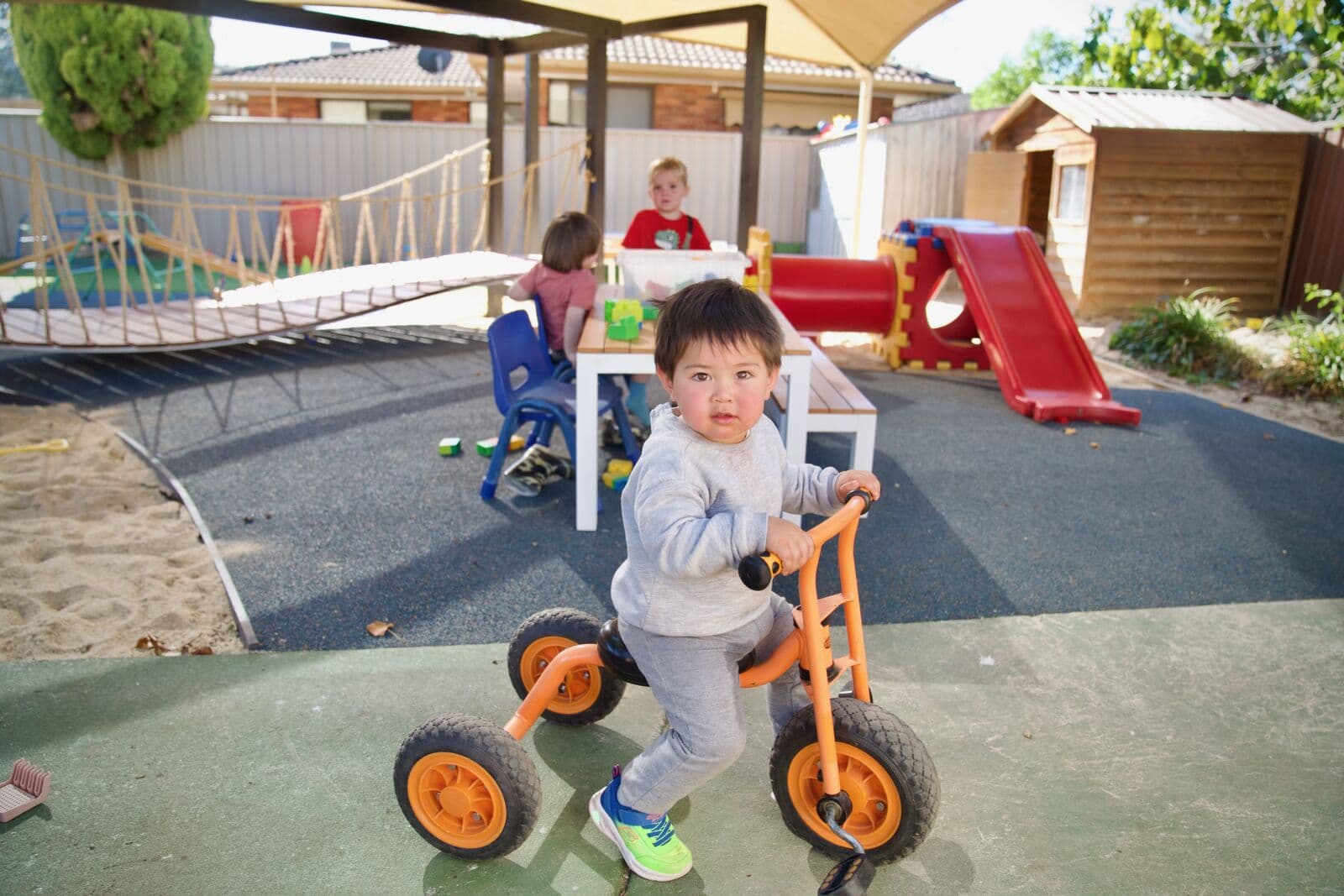
What does the outdoor space look like? Outdoor play is essential for development at this age. A good outdoor area has variety — somewhere to run, something to climb, loose materials, shade.
Does the space feel calm? Not silent — active centres have noise. But there is a difference between busy-calm and chaotic. You will feel it.
Questions worth asking on a tour
Most tours cover what a centre wants you to know. These questions get at things they might not lead with:
What is the average tenure of your educators?
Who will be my child's primary educator, and how long have they been here?
What does a typical day look like for a child my child's age?
How do you handle settling for a child who finds the transition hard?
What is your approach to outdoor play — how often, what does it look like?
What is your NQS rating, and when were you last assessed?
Are you a Kinder Tick approved provider? What does that mean for my family?
How do you communicate with parents during the day?
What happens if my child is unwell — what is the process?
What meals do you provide, and are they cooked on site?
Understand what’s included in the fee
Daily fees vary across Shepparton centres, but the headline number is rarely what families pay. The Child Care Subsidy (CCS) reduces the fee significantly for most working families — and for children in the funded kinder year, Victoria’s Free Kinder program can reduce it further.
When comparing fees, check what is included. At some centres, meals, nappies, sunscreen, and excursions are additional. At others, everything is included in the daily rate. A lower headline fee that excludes meals can easily work out more expensive in practice.
A good centre will walk you through your likely out-of-pocket cost — including the subsidy — on your tour or by phone. If they won’t, or can’t, that is worth noting.
For the year before school: check the kindergarten credentials
If your child is turning 4 and you’re looking ahead to the kindergarten year, the centre’s kinder credentials become more important. Look for:
Kinder Tick approved. The Victorian Government's Kinder Tick indicates the centre offers a high-quality kindergarten program. Kinder Tick providers are eligible to deliver funded kinder hours (Free Kinder) for 3 and 4 year olds.
Qualified Early Childhood Teacher on staff. The funded kindergarten program must be led by a degree-qualified Early Childhood Teacher (ECT), not just a Certificate III or Diploma-qualified educator. Ask whether the kinder program is ECT-led.
A curriculum framework. Victorian funded kinder programs should be delivered within the Victorian Early Years Learning and Development Framework (VEYLDF). Ask how the centre documents and plans its kinder program.
Online reviews: useful but incomplete
Google reviews, KindiCare ratings, and CareforKids entries are worth reading, but they need context. Reviews tend to be written by families who are either very happy or have had a specific grievance — the broad middle is underrepresented. A centre with 5 reviews and a 5-star average tells you much less than a centre with 40 reviews at 4.8.
Pay attention to what reviewers actually describe rather than the star rating alone. Reviews that mention specific educators by name, or describe how a child settled, are more informative than generic praise. A pattern of reviews mentioning the same educator staying for many years is a meaningful signal.
The most reliable source of honest information is word of mouth from Shepparton families whose children attend. If you know anyone with children at a centre you’re considering, ask them directly.
Family-owned vs. large chain: does it matter?
Shepparton has both family-owned independent centres and branches of national chains. The distinction matters less than the quality of the specific centre, but there are patterns worth knowing.
Larger chains have standardised curricula, consistent reporting systems, and corporate governance that can bring reliability. They can also have higher educator turnover (particularly in regional centres where the centre manager may be new to the role), templated approaches that don’t adapt well to local community, and a commercial pressure to fill places that can affect how families feel once enrolled.
Family-owned centres are more variable — the best are genuinely excellent, with deep community roots and educators who stay because they care about the specific centre and the families in it. The risks are the opposite: quality depends heavily on the owner-operator, and transition can be harder if leadership changes.
Neither is automatically better. The question to ask is whether the specific centre — whoever owns it — has the culture, credentials, and stability to do right by your child.
A note on waitlists in Shepparton
Good centres in Shepparton typically have waitlists, particularly for the nursery and toddler rooms and for the kindergarten year. If you are expecting, or your child is under one, it is not too early to enquire — even if your preferred start date is two years away.
Most centres do not charge to go on a waitlist. Being on a waitlist does not commit you to enrolment. Putting your name down at two or three centres simultaneously is completely normal and does not cause offence. Simply let each centre know if you take a place elsewhere so they can offer the spot to the next family.
What will childcare actually cost?
Our CCS guide explains the subsidy, with an interactive calculator for your own estimate.
CCS guideGuthrie Street’s programs
Nursery, Toddler, Preschool, Kindergarten, and weekly Bush Kinder — all from 6 weeks to school age.
See programs